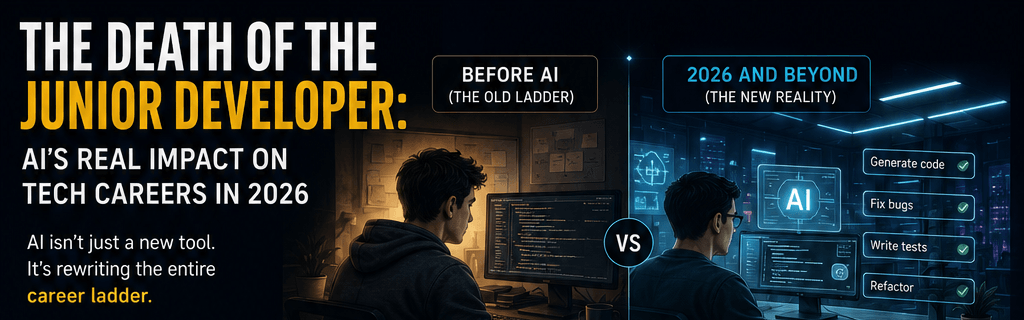
The Death of the Junior Developer: AI's Real Impact on Tech Careers in 2026
Entry-level dev jobs down 47%. Bootcamp placement collapsed to 31%. The old career path is gone. Here's what actually works now — by a web developer with 19 years of experience.
By Wadah Farah — Web Developer & Digital Professional, 19 Years Experience
I’ve been building websites and web applications since 2005. I’ve watched the industry go through multiple revolutions — the rise of WordPress, the mobile-first shift, the JavaScript framework wars, the no-code movement. Each time, people predicted the end of developers. Each time, developers adapted and the demand for good engineers grew.
This time feels different.
I’m not saying developers are finished. I’m saying the entry point has been permanently removed — and anyone planning a career in tech needs to understand what that actually means before they spend $15,000 on a bootcamp.
Lea graduated from a coding bootcamp in March 2026. She sent out 187 applications. She got zero offers.
Six months earlier, her friend graduated from the same bootcamp and landed a job in four weeks. What changed?
AI.
The junior developer job market hasn’t just tightened — it’s fundamentally restructured. And if you’re starting a career in tech, the old playbook won’t work anymore.
The Numbers Are Grim
Entry-Level Job Postings Are Down 47%
According to data from Indeed and LinkedIn, entry-level software engineering job postings have dropped 47% since January 2024. Companies aren’t hiring fewer engineers overall — they’re hiring fewer juniors.
Why? AI coding assistants like Cursor, Copilot, and Claude have made senior engineers dramatically more productive. A senior engineer with AI can now do the work that previously required a senior plus two juniors.
From where I sit: This tracks exactly with what I’ve experienced as a freelance developer. Projects I used to budget three weeks for now take one. I’m not hiring help — I’m using AI. Any client-side manager doing the math will reach the same conclusion.
Bootcamp Placement Rates Have Collapsed
The top coding bootcamps reported average six-month placement rates of 72% in 2023. By early 2026, that number had fallen to 31%.
The bootcamps haven’t changed. The market has.
Starting Salaries Are Down
For the entry-level positions that do exist, starting salaries have dropped 18–25% since 2023. Companies are treating junior roles as apprenticeships rather than career starts — and paying accordingly.
Why AI Hit Juniors Hardest
AI didn’t replace senior engineers. It replaced the tasks that juniors used to learn on.
The Grunt Work Is Gone
Junior developers traditionally spent their first year doing exactly what AI now excels at: writing boilerplate code, fixing simple bugs, writing unit tests, formatting documentation.
A senior engineer told us plainly: “I used to hire a junior to handle the boring stuff so I could focus on architecture. Now AI handles the boring stuff. I don’t need a junior.”
Honest take: This is the uncomfortable reality that bootcamps aren’t advertising. The tasks that gave junior developers a starting point — and the feedback loop to improve — are the exact tasks that disappeared first.
The Learning Loop Is Broken
The traditional career progression looked like this:
- Join a team
- Get assigned small tasks
- Make mistakes
- Get feedback from seniors
- Improve
- Get harder tasks
- Repeat
AI breaks this loop at step 2. Small tasks don’t exist anymore. The tasks that require context, judgment, and system-level thinking — the ones AI can’t handle — are also the ones juniors aren’t ready for yet.
The entry rung of the ladder has been removed. You’re expected to climb from the second rung.
Who’s Still Hiring Juniors — And Why
Some companies are still hiring entry-level engineers. The pattern is specific.
Large tech companies with structured training programs — Google, Microsoft, and Amazon still run internship-to-full-time pipelines. They can afford to invest in junior development knowing the return comes in year 2–3.
Agencies and consultancies — These companies need people for client work. Margins are lower but the variety accelerates learning faster than most corporate environments.
Early-stage startups that can’t compete on senior salaries — The tradeoff is less mentorship but more responsibility and faster growth.
Companies with legacy codebases — Maintaining old systems requires understanding business logic that AI has no context for. These teams need humans who can learn the system from the inside.
The filter has changed. The bar is no longer “can you write code” — AI can write code. The bar is now:
- Can you break down ambiguous problems?
- Can you explain technical concepts to non-technical stakeholders?
- Do you understand how components fit together at the system level?
- Can you ramp up quickly on unfamiliar codebases?
These are judgment skills. They take time to develop. And they can’t be shortcut by a three-month bootcamp.
The New Path Forward
If the old path — bootcamp → junior dev → senior dev — is broken, what replaces it?
Path 1: Build in Public
The most successful new developers we interviewed didn’t get jobs through applications. They built things and documented the process publicly.
One developer built a small SaaS tool using Cursor and published the entire process on Twitter. His code was imperfect. His builds were messy. But he showed he could ship something real. A CTO saw the thread and hired him as a founding engineer.
This resonates directly with my own experience. My career didn’t advance through credentials — it advanced through work people could see. My portfolio of real client projects has always been worth more than any certification. The principle is the same whether you’ve been working 19 years or 19 weeks. Proof of work beats proof of study every time.
Key insight: In a market where credentials are devalued, proof of work is everything. Ship real things. Document the process. Make your work visible.
Path 2: Specialize Early
Generalist junior developers are being replaced by AI. Specialists are not.
The developers getting hired combine coding with domain expertise that AI doesn’t have:
- A developer who also understands healthcare compliance and HIPAA requirements
- A developer who can build AI data pipelines for manufacturing environments
- A developer who specializes in WebGL and 3D rendering for product visualization
As someone who specialized in WordPress, WooCommerce, and e-commerce development, I can confirm this directly. Generalist web developers face brutal commodity pricing. Developers who understand a specific vertical — hospitality, retail, Arabic e-commerce platforms — command significantly higher rates because they bring business knowledge, not just technical output.
Key insight: Code is becoming a commodity. Domain knowledge is the differentiator. Pick an industry. Learn it deeply. Then code for it.
Path 3: Skip the Bootcamp, Build the Portfolio
Bootcamps have lost their value proposition. The $15,000 you’d spend on one is better invested in:
- Six months of focused self-study using AI as your personal tutor
- Building three real projects — not todo apps, not tutorial clones, but things actual people use
- Documenting everything publicly from day one
- Networking aggressively within a specific industry vertical
Multiple developers we interviewed took this path and landed roles faster than bootcamp graduates — at a fraction of the cost.
If I were starting over today, I wouldn’t pay for a bootcamp. I’d use Claude and Cursor to build three real tools, publish the process on GitHub and LinkedIn, and use the $15,000 I saved to give myself 12 months of runway to find the right opportunity. The tools available now make self-directed learning more effective than any structured program I’m aware of.
What This Means for the Industry
The Pipeline Problem
If companies stop hiring juniors, where do senior engineers come from in five years? Some organizations are already identifying this as a structural crisis. Others are betting that AI will continue reducing the need for human engineers at all levels. Both positions cannot be right simultaneously — and the answer will reshape the industry in ways we can’t fully predict yet.
The Mentorship Gap
The loss of junior roles means the loss of mentorship culture. Senior engineers who never teach struggle to develop leadership skills. Companies that stop training juniors won’t have mid-level engineers in three to four years. This is a slow-moving problem that will become suddenly visible around 2028–2029.
The Opportunity
Every market dislocation creates opportunity for those willing to see it clearly.
The developers who will thrive are not the ones waiting for the market to return to what it was. The market is not returning. The developers who will thrive are the ones who build, specialize, and prove their value through visible work rather than credentials.
My honest assessment after 19 years in this industry: The death of the junior developer role is real. But the demand for engineers who combine technical skill with genuine domain expertise, communication ability, and judgment — that demand has never been higher. The ladder got harder to climb. The destination is still worth reaching. You just have to find a different way up.
The Bottom Line
The junior developer path that worked from 2015 to 2023 is gone. A bootcamp certificate and a todo app portfolio will not get you hired in 2026.
What works now:
- Build real things — ship something people actually use
- Specialize — pick an industry and become the developer who understands that world
- Document publicly — your GitHub, your LinkedIn, your build logs are your resume
- Use AI as a tutor — Cursor and Claude can teach you faster than any bootcamp if you use them on real problems
- Skip the credential chase — nobody hiring in 2026 is impressed by a bootcamp certificate
The end of the easy path is not the end of the destination. It’s the beginning of a harder, more selective, more rewarding route for those willing to take it.
The death of the junior developer is the birth of the builder.